-
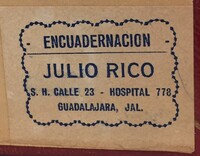 Julio Rico
-
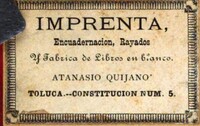 Atanasio Quijano
-
Zaehnsdorf
-
William Thomas Jennings Worsfold
-
 Wells
Wells
-
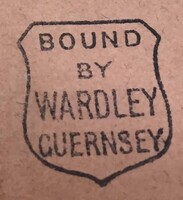 Wardley
-
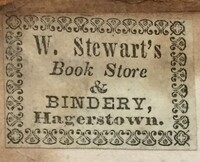 William Stewart
 William Stewart was a 19th century bookbinder originally from Hagerstown, Maryland. He later moved to Indianapolis and formed the Stewart and Bowen firm with Silas Bowen.
-
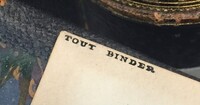 Samuel Tout
-
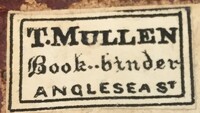 Thomas Mullen
-
 Talleres de la Penitenciaria
 A prison bindery in the Mexican state of Nayarit.
-
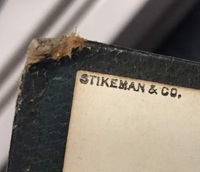 Henry Stikeman
 Henry Stikeman founded the "Stikeman & Co." bindery in 1887.
-
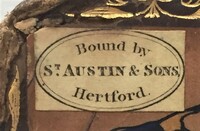 St. Austin and Sons
-
 Sangorski and Sutcliffe
-
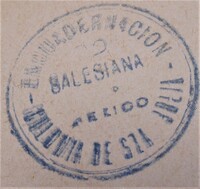 Colegio Salesiano Santa Julia
 A Salesian school located in the Anáhuac neighborhood of Mexico City, which had a trade school component, which provided training in bookbinding, printing, carpentry, and other crafts.
-
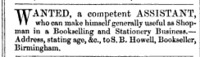 S.B. Howell
-
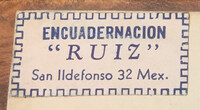 Ruiz
Ruiz
-
Rodolfo Picardo
-
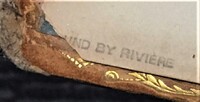 Riviere
-
Ringer and Hertzberg
A bookbinding firm located in Chicago, owned by Ernst Hertzberg and Philip Ringer. The name changed to the Ernst Hertzberg & Sons Monastery HIll Bindery in 1907 when Ernst bought out Ringer's share of the firm.
-
 Ramón de San Nicolás Araluce
-
Peter A. Demeter
-
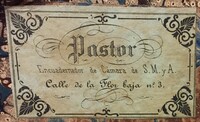 Pedro Pastor
-
 P. A. Norstedt
-
Offizin W. Drugulin
-
 Oberti and Pesci
 A bindery located in Genoa, Italy.
-
 Nicolas
-
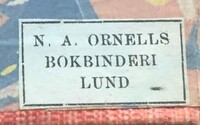 N.A. Ornells
-
Muller and Woeflin
-
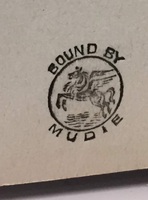 Mudie
Mudie " These books were bound in the bookbinding division, the fourth branch of the company, found on the upper floors of the New Oxford Street building, where the repairing of worn library volumesand the stitching of the numnerous catalogues also was done. The style of calf binding developed here became famous as "Mudie calf"." Griest, Guinevere. “A Victorian Leviathan: Mudie’s Select Library.” Nineteenth-Century Fiction, vol. 20, no. 2, University of California Press, Sept. 1965, pp. 103–26, doi:10.2307/2932540.
-
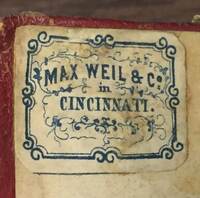 Max Weil & Co.
 A bookbinding firm in Cincinnati, Ohio, in the early 20th century. Also advertised as "Booksellers & Blank Book Dealers, Stationers, Printers & Envelope Makers" on company stationery.
-
Martin Kausche
-
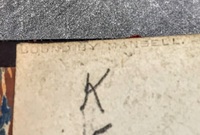 Mansell
-
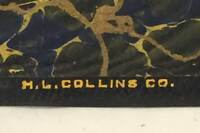 M.L. Collins
-
Louis Pouillet
Established in Paris around 1870 at n ° 5 rue du Pont-de-Lodi then 3 cours du Commerce-Saint-André. Practiced his profession until his death at the age of seventy. His daughter succeeded him and practiced until around 1950" (from BNF entry)
-
 Livraria Castro e Silva
-
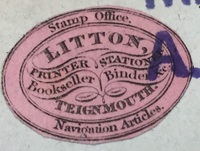 Litton
-
Librairie Bonneau
-
Legatoria Torriani
-
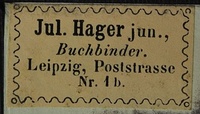 Julius Hager
-
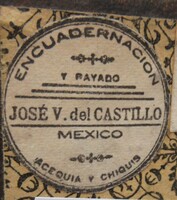 Jose V. del Castillo
-
John Bumpus
-
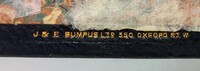 John and Edward Bumpus Ltd.
-
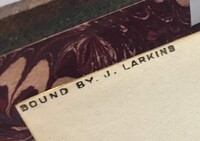 Jeremiah Larkins
-
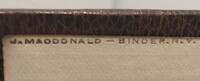 James MacDonald
-
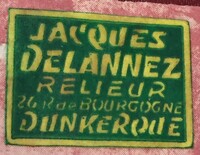 Jacques Delannez
-
J.S. Wilson & Son
-
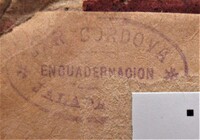 J.R. Cordova
-
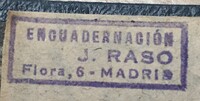 J Raso
-
J. Prinzing
-
J. Clarke
-
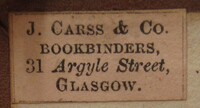 J. Carss & Co
-
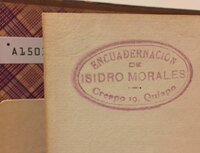 Isidro Morales
 A bookbinder who worked in the Quiapo district of the city of Manila, in the Philippines.
-
Henry Joseph Pierson
-
Heffe und Beder
-
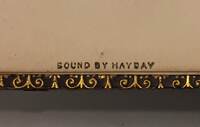 James Hayday
 HAYDAY, JAMES (1796–1872), book-binder, born in London in 1796, served his time with Charles Marchant, vellum-binder, 12 Gloucester Street, Queen Square, and then for some time worked as a journeyman. In 1825 he became one of the auditors of the Journeymen Bookbinders' Trade Society. He commenced business in a very humble way. In 1833 he rented premises at 31 Little Queen Street, Lincoln's Inn Fields, where he continued until his retirement in 1861. Hayday had long seen that it was desirable to make printed books open freely and lie flat; his attention is believed to have been drawn to this matter by seeing Bagster's polyglot bibles, which were bound by Joseph Welsh of 10 Queen Street, Golden Square, in what was known as ‘Bagster's Renowned Binding.’ These books were made flexible, and covered with purple pin-headed sealskin with a blind tool ornament. In his own binding he sewed the books all along every sheet, and to remedy the extra thickness that would be caused by sewing with thread, used silk, and to equalise the thickness rounded the fore edges more than was customary. To make the back tight he dispensed with the ordinary backing of paper, and fastened the leather cover down to the back. Still the constant opening of the book disfigured the grain of the leather, and to obviate this he introduced the cross or pin-headed grain, or what is now termed Turkey morocco. Works bound by Hayday became famous, and his name attached to a book raised its value twenty-five per cent. Edward Gardner of the Oxford Warehouse, 7 Paternoster Row, secured Hayday's services for the Oxford books exclusively. William Pickering, bookseller, of 57 Chancery Lane, gave him the benefit of his long experience, and introduced him to many wealthy patrons. After entering into a brief partnership with Mr. Boyce, ‘a finisher,’ he again started on his own account at 31 Little Queen Street. Unable to compete with other and cheaper binders, he was adjudicated a bankrupt on 10 June 1861.
He sold the use of his name to William Mansell, who succeeded to the bookbinding establishment. Retiring to St. Leonard's-on-Sea, Hayday died there on 19 March 1872, aged 76.
-
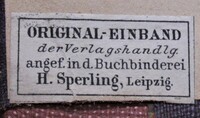 H. Sperling
-
Gresswell
-
G. Desnaux
-
Fried Bruckmann
-
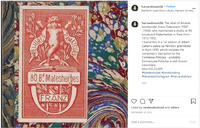 Franz Ostermann
 "Coming to Paris after 1870, he founded his workshop in 1872 at 80 boulevard Malesherbes, then transferred it to 28 rue Ampère in 1902". (https://data.bnf.fr/fr/16007987/franz_ostermann/)
-
Franz Lysakowski
-
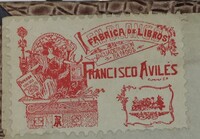 Francisco Aviles
 Bookbinder, printer, and blank book seller from Guatemala City, Guatemala. Advertisements before the 1917 earthquake list his address as "11 Calle Oriente, Junto al Edificio San Marcos". The Edificio San Marcos was the home of the Hotel Imperial, which was located in the Zone 1 district, on Calle 11 at Avenida 8a. So his bindery was next to the Hotel Imperial, at least until the earthquake hit in 1915.
Aviles was also a signer to the 1892 statues of the "El Porvenir de los Obreros" ("Future of the Workers Society") a mutual aid society of unionized craftspeople and artisans.
-
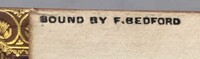 Francis Bedford
 BEDFORD, FRANCIS (1799–1883), bookbinder, was born at Paddington, London, on 18 June 1799. His father is believed to have been a courier attached to the establishment of George III. At an early age he was sent to a school in Yorkshire, and on his return to London his guardian, Henry Bower, of 38 Great Marlborough Street, apprenticed him in 1817 to a bookbinder named Haigh, in Poland Street, Oxford Street. Only a part of his time was served with Haigh, and in 1822 he was transferred to a binder named Finlay, also of Poland Street, with whom his indentures were completed. At the end of his apprenticeship he entered the workshop of one of the best bookbinders of the day, Charles Lewis [q. v.], of 35 Duke Street, St. James's, with whom he worked until the death of his employer, and subsequently managed thebusiness for Lewis's widow. It was during this period that Bedford's talent and industry attracted the notice of the Duke of Portland, who became not only one of his most liberal patrons, but also one of his staunchest and kindest friends. In 1841 Bedford, who had left Mrs. Lewis's establishment, entered into partnership with John Clarke of 61 Frith Street, Soho, who had a special reputation for binding books in tree-marbled calf. Clarke and Bedford carried on their business in Frith Street until 1850, when the partnership was dissolved. In 1851 Bedford went to the Cape of Good Hope for the benefit of his health, where he remained a considerable time, the expenses of his journey being defrayed by the Duke of Portland, and on his return to England he established himself in Blue Anchor Yard, York Street, Westminster. He afterwards added 91 York Street to his premises, and remained there until his death, which took place at his residence at Shepherd's Bush, Hammersmith, on 8 June 1883. Bedford was twice married, but had no children by either of his wives.
The work of Bedford is not excelled by that of any English bookbinder of his time. If not distinguished by much originality, it is always in good taste, and although it may not be quite equal in finish to that of the best of the contemporary French binders, for soundness and thoroughness it could not be surpassed. Bedford appreciated tall copies, and a book never came from his hands shorn of its margins. He was also a very skilful mender of damaged leaves. The number of volumes bound by him is very large, and for many years a continuous stream of beautiful bindings issued from his workshops, the great majority of which are now to be found on the shelves of the finest libraries of England and America. Many of his choicest productions are imitations of the work of the great French bookbinders of the sixteenth, seventeenth, and eighteenth centuries, and the bindings of Rogers's 'Poems' and 'Italy,' of which he bound several copies in morocco inlaid with coloured leathers and covered with delicate gold tooling in the style of Padeloup, are exquisite specimens of his skill. These two volumes have repeatedly realised upwards of one hundred guineas. Bedford himself considered that an edition of Dante, which he bound in brown morocco and tooled with a Grolier pattern, was his chef d'oeuvre, and wished it placed in his coffin ; but his request was not complied with, and it was sold at the sale of his books for 49l. He obtained prize medals at several of the great English and French exhibitions. His books were disposed of by Sotheby, Wilkinson, & Hodge, in March 1884, and realised 4,876l. 16s. 6d. Many of the best examples of his work were among them. In addition to his skill as a bookbinder, Bedford possessed much literary and bibliographical knowledge.
-
Eyre and Spottiswoode
-
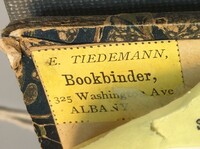 Ernest Tiedemann
 Ernest Tiedemann was a bookbinder in Albany, New York. He was born in 1839 and died in 1902.
-
Engel et fils
-
 Skelton
-
 Crispin Marquez
 Bookbinder from Guaymas, in the Mexican state of Sonora.
-
 Charles Winstanley
-
Carl Albert Kindle
-
Capre and Carpegna
-
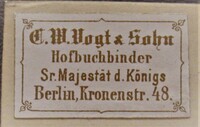 Vogt
Vogt C.W. Vogt was a German bookbinder who served as a Court bookbinder alongside Ernst Collins.
-
Burn & Co
-
Boutan-Marguin
-
Blunson and Co.
-
Blackwell
-
Birdsall
-
Bickers and Son
-
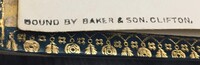 Baker and Son
-
James Baker
-
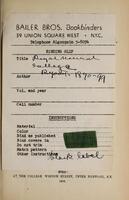 Bailer Bros.
 Bailer Bros. was a large bookbindery firm located in Union Square, in New York City, during the 20th century.
-
Atelier Bindery for Charles Scribners Sons
-
 Angel Ureña
 Angel Ureña was a 20th century Dominican bookbinder who ran the "Benefactor" bindery and bookbinding school in the city now known as Santo Domingo.
-
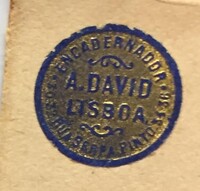 Alfredo David
-
Alexander Milne
"Alexander Milne of Forres (c. 1779-1849), who settled in Forres in 1798, initially working as master of the grammar school and then becoming a bookbinder, bookseller and stationer in the early nineteenth century." (Description from Quaritch bookseller catalog (https://www.quaritch.com/wp-content/uploads/2016/02/Edinburgh-2016.pdf))
-
Acres, Blackmar and Co.
A blank book manufacturer and printing firm located in Burlington Iowa. It was founded by S.F. Acres; Edwin Carlton Blackmar joined the firm in 1867. In 1879 the firm was reorganized as a corporation, and Mr. Blackmar became the secretary of the company. Mr. Acres died in 1890, and Blackmar took over as president. He held that title in the company until his death in 1900.
-
Albert Valat
A French bookbinder, whose ticket lists "Reliure, Dorure, Cartonnages", at 1. Rue Cambaceres, Montpellier. He is listed in a 1905 guide
-
 A. Nienhuis