“On the evils of oversewing”
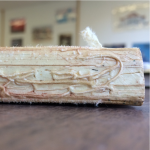
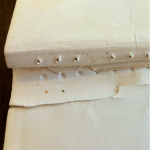
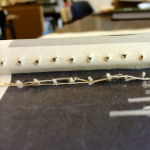
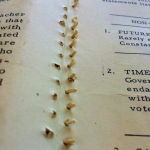
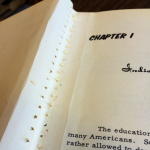
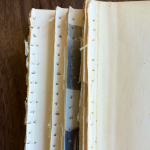
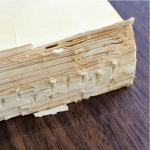
Oversewing is a “repair” technique used by commercial binderies (and now fortunately out of fashion), but it also was used a primary sewing structure back in the day as well. What you’re looking at is an example of the former, where a modern book has its spine chopped off, and then was oversewn by sections, and then glued together and cased in as usual.
Per Etherington and Robert’s definition:
“A method of sewing the leaves of a book by hand or machine, almost always the latter in library binding. The sewing thread passes through the edges of each "section,” in consecutive order, using pre-punched holes through which the sewing needles pass.
The oversewing process generally entails the removal of the original spine lining cloth. glue, original sewing, and the folds of the sections, which is usually accomplished by planing, grinding, sawing, or cutting the spine of the book, thus removing an eighth of an inch or more of the binding margin. Sometimes the spine is first nipped to remove the original backing shoulders before the folds are removed. The book, having been reduced to individual leaves, is then jogged, and a very light coat of glue is applied along the binding edge to hold the leaves together temporarily. A number of leaves, or a “section,” between 0.055 and 0.065 inch in thickness (depending upon the thickness of the paper) is then sewn, either by hand, or, more commonly, in an oversewing machine. The thread passes through the section perpendicular to the plane of the paper (Holloway method) or obliquely. This later, diagonal method is known as the CHIVERS method, which is employed in oversewing machines. Altogether, about 5/16 or 6/16th inch of the binding margin is consumed by the process.
Hand oversewing was in common use by the end of the 18th century and the beginning of the 19th, particularly for large books and those with loose plates. The oversewing machine, which was invented and perfected in the first quarter of the 20th century, is the principal sewing machine employed by library binders in the United States.“
Over time, the pages started to break at the point where they drape over the next page (I can’t remember the term for this exactly, my bad). This is because the movement of the spine is restricted, so the paper is doing ALL the work, and as a result it has weakened over time. This particular book suffered much less than others I have seen; when you find a brittle 19th century book that has been oversewn in this way, it’s usually been reduced to a pile of single sheets from breakage.
As this book is going into one of our special collections, I’ve decided to give it a particularly loving treatment: section by section I’ve been picking out all the oversewing and disbinding it back into a pile of single sheets. From there I’ll probably flatten the pages and smooth out the shot-gun scatter of holes along the spine edge, and guard over the holes with heat-set tissue. Then we may send it to the bindery again, but this time for an adhesive binding, which should allow the book to open fully into the gutter, unlike its previously oversewn binding. Another option would be to actually guard it into sections and sew it up with a regular all-along sewing and bind it with a case binding. After I’ve had my coffee, and thought about it some more, I’ll figure out how I want to proceed.
Until then, consider yourself educated about the evils of oversewing!